Vault Beneath the Library
The CEO’s Baby Girl: A Workplace Reverse Harem Romance (Age-Gap Billionaire Obsessions)The Vault Beneath the Library is a hidden chamber beneath the library at Dominic Vale’s estate and the decisive site of Ariella Monroe’s first direct encounter with the material history of Project Marrow. Concealed behind a wall and unknown even to Ariella before her discovery, it turns an apparently intimate magical relationship into evidence of a larger program in which bonded women are classified, tested, altered, and discarded. The vault’s importance lies not only in what it contains, but in the way its objects make suppressed history physically present.
Discovery and Access
The vault enters the plot through an anonymous message sent to Ariella after a night with Dominic Vale. The message warns that Dominic did not bind her for protection, but to control what he had broken, and directs her to check the vault beneath the library and ask Luca about Project Marrow. The message makes the location a challenge to the official story surrounding Ariella’s binding: knowledge is displaced from Dominic’s spoken authority into an unknown written communication and a forbidden architectural space.
Ariella initially considers deleting the message and returning to the security of Dominic Vale’s bed, but the repeated words “The library. The vault.” turn concealment into compulsion. She dresses quickly and goes to investigate without the ornamental clothing associated with her earlier presentation of herself. The movement is therefore both physical and interpretive: she leaves the scene in which she has been treated as Dominic’s possession and enters a place where his power may be read through records rather than received through his commands.
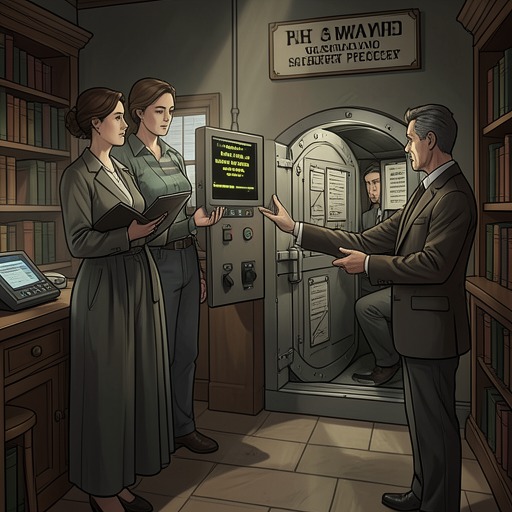
The entrance is activated through a concealed seam in the stone. Ariella has never seen the vault and had not known that it existed, yet her fingers find a feature that had previously been invisible. When she touches the central symbol, a vertical slash through a crescent moon, the wall trembles and opens. Cold air pours from the passage like breath from a forgotten crypt. The vault is thus presented as a sealed memory made architectural: dormant, inaccessible, and suddenly responsive when Ariella’s investigation reaches the correct sign.
Physical Description and Contents
The chamber is small and circular, sharply unlike the expansive public spaces associated with Vale Enterprises and Dominic Vale’s office. Dominic’s office is a vast cathedral of glass and steel suspended above the city, with a black marble desk veined in gold; the vault reverses that vertical spectacle with enclosure, stone, darkness, and stored evidence. Its circular form and underground position give it the character of a repository beneath the visible order of the Vale world, a place where what cannot be displayed is nevertheless preserved.
Shelves line the chamber, holding scrolls, files, and strange black orbs that pulse faintly inside glass cages. These objects combine bureaucratic and occult forms of storage. The scrolls suggest an older magical history, while the files suggest classification and administrative control; the imprisoned orbs add a living or active quality to the collection, as though the chamber stores not only information but contained forces. The vault’s contents therefore make knowledge feel material, dangerous, and subject to custody.
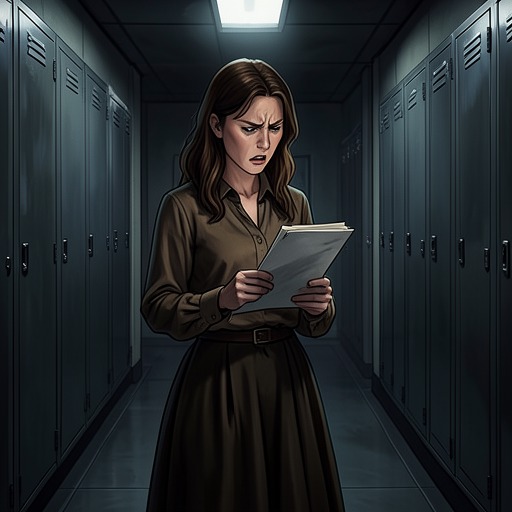
At the center stands a pedestal bearing a single thick file. Its central placement gives the document the force of an exhibit or an altar, but its label is clinical rather than sacred: “PROJECT MARROW: SUBJECT A.001.” The file becomes the vault’s most consequential object because it translates a woman’s experience into institutional language. Ariella does not merely hear that another girl existed; she encounters a record that has assigned her a subject number and reduced her fate to a case within a larger system.
Project Marrow Evidence
Inside the file, Ariella sees a young woman bound in ritual and marked in the same manner as Ariella. The woman is described as pale, tear-streaked, and beautiful, but her eyes are empty. The visual resemblance establishes continuity between the archived subject and Ariella, while the emptiness of the woman’s expression anticipates the danger of losing agency, memory, or both. The file makes the previous girl’s absence legible without restoring her voice.
The report’s language is dry and clinical. It states that the subject displayed accelerated magical adaptation when bonded with the Primary, that intimacy significantly amplified latent channels, and that emotional attachment was unnecessary for the bond’s efficacy. The report then records that the subject was terminated after attempting a breach, with secondary candidates pending. The vocabulary of adaptation, efficacy, breach, and candidates strips away the language of romance and exposes a research structure: magical bonding is being measured for performance, while intimacy is treated as an instrument rather than a mutual relation.
This record confirms the darkest implication of Jenna’s warning. Jenna had told Ariella that the previous participant was an intern, younger than Ariella, who entered expecting the job of her dreams and was taken and twisted into Dominic Vale’s fantasy. The vault supplies the institutional counterpart to that oral testimony. Jenna provides the memory of a person and the fear surrounding her disappearance; the file supplies a numbered subject and a termination entry. Together, they reveal that the previous girl was not an isolated failure but part of a sequence in which other candidates were already anticipated.
Narrative Consequences
The vault changes the meaning of Dominic Vale’s binding. Before Ariella enters it, the binding can still be interpreted within the language of protection, desire, discipline, or possessive intimacy. The message and the file introduce a competing explanation: Dominic’s magic may be preserving control over damage produced by his own experiment. The secret chamber therefore converts suspicion into documentary evidence, though the evidence itself remains shaped by the authority that produced it and by the subject’s removal from the record as a living speaker.
The location also establishes a conflict between access and erasure. Ariella must cross a hidden threshold to reach the archive, and what she finds there has been organized by the very system whose conduct it condemns. The vault preserves the previous subject as an image, a number, and a clinical outcome, but not as an account of her own intentions. Its apparent function as a storehouse of truth is inseparable from its function as a mechanism of classification. The record reveals enough to implicate the Primary while withholding the full history of the woman who was terminated.
The vault’s implications extend beyond its immediate discovery. Later, Isadora Vale causes Ariella’s magic to implode, leaving Ariella unconscious, powerless, and without memory. That later erasure gives the vault’s records an additional significance: memory in this world can be removed from a person, while documents can preserve a distorted institutional version of events. The chamber becomes a counterpoint to magical amnesia, but not a simple guarantee against it. What survives in the vault is evidence, not necessarily justice.
Symbolic and Narrative Significance
As an underground archive, the Vault Beneath the Library spatializes the hidden history beneath Dominic Vale’s polished authority. The library ordinarily suggests learning and interpretation, but the concealed chamber beneath it reveals that knowledge is stratified: the visible collection is not the whole repository, and the most dangerous truths are kept below the recognized space of study. The descent is consequently a movement from surface narrative to buried structure.
The chamber’s objects also expose the material politics of power. A message on Ariella’s phone begins the investigation; a seam in stone permits entry; a symbol triggers the opening; shelves hold scrolls, files, and pulsing black orbs; and the labeled file turns a human life into a controlled artifact. Each object mediates access to knowledge. The vault is not merely a room containing secrets but a device that determines who may find them, how they are named, and what kind of truth they can communicate.
Its greatest narrative function is to make Ariella’s awakening evidentiary. Her unease is no longer based solely on Dominic Vale’s rules, Jenna’s warning, or the intensity of the magical bond. She has seen a marked woman who resembles her, read that intimacy was used to amplify magical channels, and learned that a prior subject was terminated after attempting escape. From that point onward, the relationship’s language of desire and discipline is shadowed by the archive’s colder vocabulary of subjects, primaries, breaches, and candidates. The vault is the place where private possession becomes a documented system, and where Ariella begins to understand that recovering her autonomy requires recovering the history that power has tried to bury.